
Why Korean Cafes Are Often Multi-Floor Instead of Quick Stop Counters
If you visit Korea, one of the first things you notice is how many cafes there are. The second surprise is that many Seoul cafes are not single-floor counters like typical quick-stop formats in the US, but multi-floor spaces. This post looks at why that pattern became so common.
Surface Layer
On the surface, the answer is simple: in Korea, a cafe is often not just a place to buy coffee quickly. It works more like a place to stay.
People meet friends, study, do light laptop work, and spend solo time in the same space. That mixed use creates stronger seat demand, so expanding across two to four floors becomes a practical operating model.
Many visitors first read this as pure oversupply. But in Korea, cafes are embedded in everyday movement almost like convenience stores or casual restaurants, so raw shop counts alone do not explain demand.
Deep Layers
Cultural and Social Background
Korean social life still carries a long Confucian legacy in everyday etiquette and relationship dynamics. This is less about religion in a strict doctrinal sense, and more about social norms that shape tone, hierarchy, and communication style.
That does not mean people are unable to speak directly. But in many settings, people still try to avoid face-to-face confrontation and manage disagreement with softer phrasing. In that context, cafes became a neutral space between home and work where people could share updates, build social comfort, and speak more openly.
This is why some Koreans interpret cafes as a place where bottled-up thoughts can be expressed more safely. It is not a universal rule, but it is a useful lens for understanding why cafes in Korea became social conversation spaces, not just beverage stores.
Strong academic pressure is another layer. Students, job seekers, and office workers all need semi-quiet places to stay for long sessions, and cafe study culture (“cagong”) normalized that long-stay behavior.
Economic Analysis
Economically, this is not just a fast-turnover model. It is a model that converts dwell time into revenue. To support long-stay demand, operators design for seating volume, vertical zoning, outlet access, and atmosphere.
Location economics matter too. Around transit nodes, campuses, office clusters, and dense apartment zones, demand comes in waves all day: morning takeout, midday meetings, afternoon study, evening conversation.
Multi-floor layouts also align with rent structure. Expensive first-floor visibility is used for ordering and brand exposure, while upper floors absorb most seat time. That is why first floors may look crowded even when upper floors still have space.
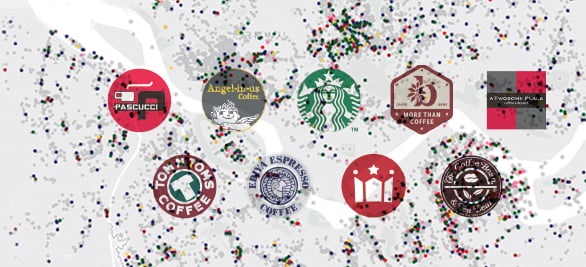
The cafemap pattern should be read through this lens. It is not only a trend map. It also reflects where movement patterns and long-stay demand overlap.
At the same time, the budget coffee segment has entered a capital-intensive expansion phase. In recent years, large low-price chains backed by private equity have accelerated store openings. That can grow footprint quickly, but it also raises pressure around saturation, franchisee margins, and long-term differentiation.
So Seoul’s cafe density is best explained as a combined outcome: cultural demand, study-driven long stays, and capital-led expansion competition.