
Bukchon Hanok Village Is Real. What KPop Demon Hunters Reimagines
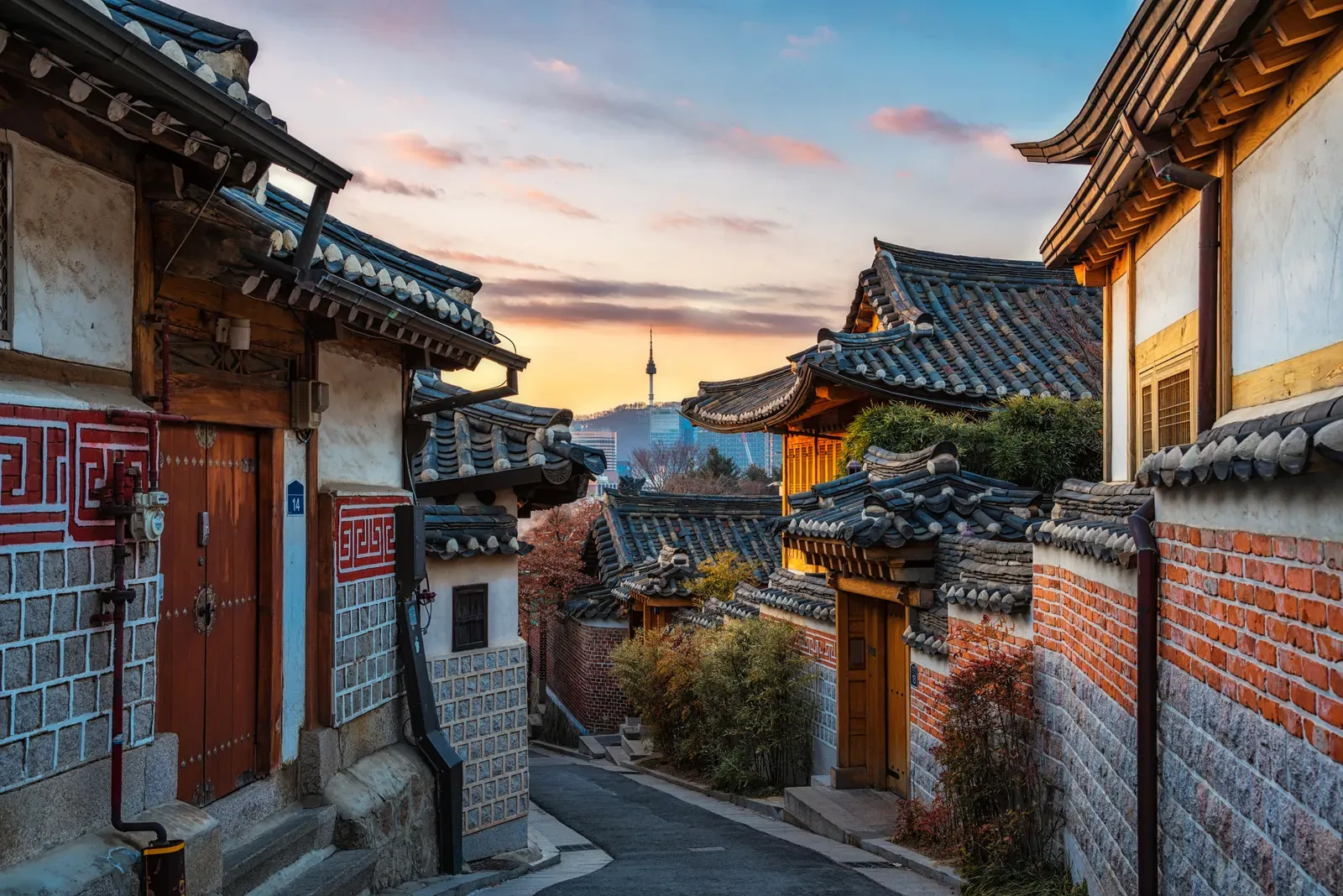
If Bukchon Hanok Village made you stop the movie and open a map after watching KPop Demon Hunters, that reaction makes sense. Netflix’s own location guide lists Bukchon as one of the real Seoul places reimagined in the film. But the useful answer is not just that Bukchon is real. The more interesting answer is why this neighborhood feels so visually convincing on screen in the first place.
Bukchon works because it is one of the rare places in central Seoul where court-era geography, 1930s urban hanok, and a modern city skyline all sit on the same slope. That layered look is exactly what the movie borrows.
Why Bukchon feels real in KPop Demon Hunters
The first thing to clear up is the obvious one. KPop Demon Hunters is animated, so Bukchon is not a live-action filming location in the normal sense. What Netflix says is more specific: the production team studied real Seoul locations, used real terrain data, and reimagined places like Bukchon inside the film’s stylized version of the city.
That distinction matters. The neighborhood is not interesting because a camera happened to point at it. It is interesting because Bukchon already has the kind of visual logic that animation artists want. Narrow alleys, steep gradients, tiled rooflines, and sudden openings toward the city all make the place read clearly even after stylization.
So if you recognized Bukchon in the movie, you were not imagining it. You were noticing that the film leaned on a real Seoul landscape that already looks cinematic.
What Bukchon actually is
Bukchon means “north village.” It sits between Gyeongbokgung and Changdeokgung, in the part of old Seoul that historically held elite residential areas north of Jongno and Cheonggyecheon. That court-era geography still matters. Even now, Bukchon feels tied to the palace zone in a way that newer neighborhoods do not.
But this is also the part many visitors get wrong. The neighborhood people photograph today is not a frozen Joseon-era street preserved intact for six hundred years. The Seoul Hanok Portal explains that Bukchon changed heavily in the early twentieth century, especially in the 1930s, when large plots were subdivided and groups of medium-sized urban hanok were built as Seoul’s population grew and the city center densified.
That is why Bukchon feels both old and unexpectedly compact. The houses are traditional in material and silhouette, but many of them belong to a more urban, modernized hanok story than visitors first assume. Seoul’s own hanok material even points out details such as glass doors added to daecheong halls and galvanized sheet extensions at the eaves. In other words, Bukchon is not valuable because it escaped change. It is valuable because it shows how Korean housing adapted to change without losing its basic form.
This is the local layer many tourists miss. Bukchon is not just “old Korea.” It is old Seoul, modern Seoul, and preservation-era Seoul all stacked together.
Why the neighborhood looks so dramatic on screen
Bukchon’s topography does a lot of the visual work. The neighborhood sits on sloping ground south of Bukaksan, and the Seoul Hanok Portal notes that its northern side is higher than the south. That matters when you are standing in an alley. Rooflines do not spread flat across the frame. They climb, step, compress, and open.
That is why even a still photo from Bukchon feels layered. From one angle you get repeating tile lines and timber eaves. From another you get hanok rooftops with modern Seoul rising behind them. In a city where so much housing was rebuilt into apartment blocks, Bukchon still gives you a rare view of low-rise historical texture inside a dense capital.
The neighborhood also reads well because it is tight. The alleys are narrow enough to feel intimate but not so narrow that the roof shapes disappear. When a scene wants tension, secrecy, or sudden elevation change, Bukchon gives it naturally. Animation exaggerates that effect, but it does not invent it from nothing.
Which is why Bukchon keeps showing up whenever creators want “historic Seoul” to feel lived-in rather than museum-like.
Why locals are protective of Bukchon
Most first-time visitors see Bukchon as a beautiful place to walk. Locals also see that, but they see something else first: people live there.
This has become a serious issue over the last decade as tourism intensified. Jongno-gu now treats Bukchon as a special management area, and the red-zone restriction around Bukchon-ro 11-gil moved from a trial period into full enforcement on March 1, 2025. Tourists are allowed in the restricted area only from 10:00 a.m. to 5:00 p.m., and entering for tourism outside those hours can trigger a 100,000 won fine.
That policy tells you how Korea now talks about Bukchon. It is no longer just a picturesque neighborhood with hanok. It is a neighborhood where tourism got large enough to interfere with ordinary life, and the district government had to step in on behalf of residents.
That is also why the standard etiquette rules are so blunt. Keep your voice down. Do not use loudspeakers. Do not peer into open doors or windows. Do not film interiors of private homes. Take your trash with you. Keep group visits small. Bukchon is not asking visitors to admire a heritage district from a distance. It is asking them not to behave like the residents stopped mattering once the view became popular online.
Frequently Asked Questions
Is Bukchon Hanok Village really in KPop Demon Hunters?
Yes, in the sense that Bukchon is one of the real Seoul locations the movie reimagines. Netflix’s official guide includes it in the film’s location breakdown. Because the movie is animated, it is better to think of Bukchon as a real neighborhood that shaped the design rather than a live-action set.
Is Bukchon Hanok Village free to visit?
Yes. Walking through the neighborhood is free. What changes is access to restricted areas during certain hours, not ticketed entry to the village itself.
What are Bukchon’s restricted hours?
The restricted tourist zone is open from 10:00 a.m. to 5:00 p.m. The current Jongno-gu rule says tourists entering the restricted area outside those hours for sightseeing can be fined 100,000 won.
How long does Bukchon Hanok Village take to visit?
If you only want the famous roofline viewpoints, you can move through the area quickly. If you follow the official walking route through the village, expect about 2 to 3 hours. Add more time if you plan to stop at galleries, craft shops, cafes, or a nearby palace.
Can you go inside the hanok in Bukchon?
Usually no. Most hanok in Bukchon are private homes. A few are open because they operate as cultural spaces, museums, cafes, galleries, or guesthouses, but you should assume a gate is private unless it is clearly marked otherwise.
Which subway stop is closest to Bukchon?
Anguk Station on Seoul Subway Line 3 is the standard starting point. The walk from the station into Bukchon is short, but the neighborhood itself is hilly, so the part that feels close on a map can still take longer on foot than people expect.
Can you wear hanbok in Bukchon?
Yes. Many visitors rent hanbok around Anguk Station and pair Bukchon with a palace visit. If you also go to Gyeongbokgung, the palace’s official guideline says both traditional hanbok and everyday-style hanbok qualify for free admission when worn properly.
Visiting Bukchon without treating it like a set
The easiest way to approach Bukchon is to start at Anguk Station, walk into the village gradually, and decide whether you want a quick viewpoint stop or a longer wander. If you are there mainly because of KPop Demon Hunters, focus first on the shape of the place: the slope, the rooflines, the way palace-era Seoul and modern Seoul overlap in the same frame. That is the part the movie is really borrowing.
If you are there to explore, the official walking material gives a better sense of scale than social media does. Bukchon is not one single photo point. It is a spread of alleys, public hanok spaces, small museums, and connected landmarks. That is why a proper walk takes longer than many first-time visitors expect.
The main thing is to remember what Bukchon is before it is a tourist attraction. It is a residential neighborhood with a long memory. If you treat it like a backdrop, you will leave with the shallow version. If you pay attention to why the houses are packed so tightly, why the roofs step the way they do, and why the district now limits visitor hours, you will understand something much closer to the real place.
Reporting note
The film-location reference was checked against Netflix Tudum. Visitor-hour restrictions, access guidance, official walking-route timing, and hanbok admission guidance were checked against Jongno-gu, Visit Seoul, the Seoul Hanok Portal, and the Royal Palaces and Tombs Center on April 12, 2026.
Location Guide: Bukchon Hanok Village
Loading map
Bukchon is a residential neighborhood. Restricted-area visits are allowed from 10:00 a.m. to 5:00 p.m. only, and quiet behavior matters.