
Woljeonggyo Bridge in Gyeongju Is Not Just a Love Bridge
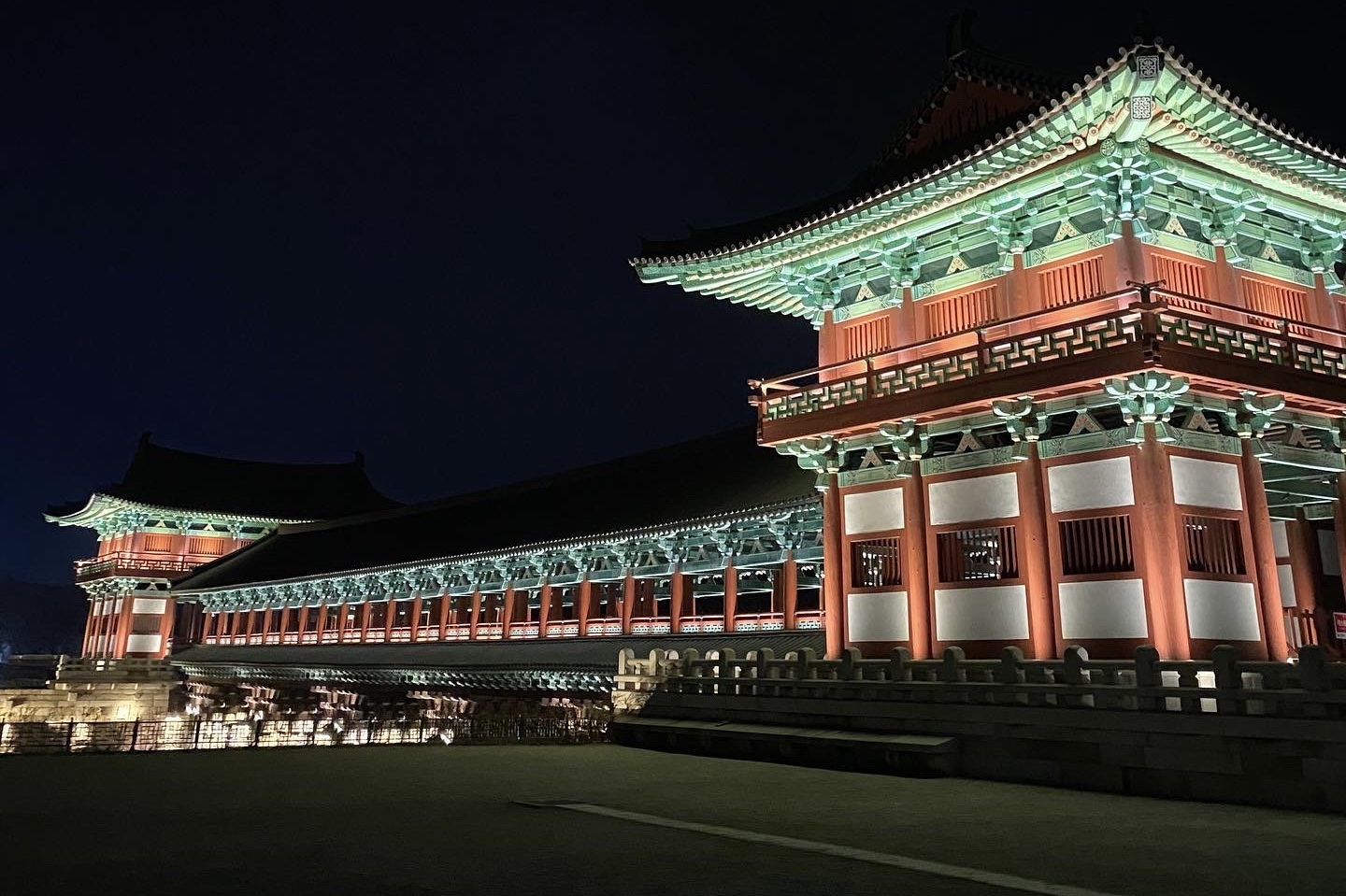
Most visitors first encounter Woljeonggyo at night. The illuminated wooden gatehouse, the warm reflection doubling across the Muncheon stream, the couples walking slowly across the deck — everything about the scene reads as romantic. Social media calls it a love bridge. Tourism posts lean into the association. But the romance is a modern overlay on a structure that was built for an entirely different reason.
Woljeonggyo was state-level infrastructure for the Unified Silla royal capital. Understanding that changes how the bridge looks once you know.
What Woljeonggyo actually was
The Samguk Sagi records that Woljeonggyo and its companion Chunyanggyo were built across the Muncheon stream south of Wolseong Palace in the 19th year of King Gyeongdeok’s reign — 760 AD. That single detail already tells you this was not a neighborhood footbridge. Building two named bridges on the southern approach to the palace district meant organizing how people and goods moved through the capital.
Woljeonggyo sat on the axis between the Wolseong palace zone and the residential and ritual areas to the south, including the direction of Namsan. In the Silla capital’s spatial logic, this was a controlled threshold — a point where the city’s administrative core met its outer fabric. The bridge was not decorative. It was connective tissue for a planned capital.
The original structure was destroyed by fire during the Joseon Dynasty. For centuries, only the stone pier foundations remained in the streambed, slowly buried under sediment.
Why visitors think it is a love bridge
The romantic association comes from a story that technically belongs to a different bridge.
The monk Wonhyo and Princess Yoseok are one of the most recognizable love stories in Korean cultural memory. The popular version says Wonhyo crossed a bridge near this spot on his way to the princess’s residence, fell into the water, and changed his robes at her palace — which led to their relationship and eventually to the birth of the scholar Seol Chong.
The problem is that the story predates Woljeonggyo. Wonhyo lived in the 7th century. Woljeonggyo was built in 760 AD, decades later. The bridge associated with the Wonhyo episode is called Yugyo, and its site sits roughly 20 meters west of Woljeonggyo. Because an informational sign about the Wonhyo story was installed near the restored bridge, the two became fused in popular imagination.
That fusion is not a scandal — it is how cultural landscapes work. Gyochon Village sits nearby, the stream is the same, and the evening atmosphere genuinely feels like a place where old stories should live. But if you want to be precise: Woljeonggyo is a royal-capital bridge that inherited a love story from its neighbor.
What the restored bridge actually looks like
The bridge you walk across today is the result of a two-phase restoration completed in 2018. Phase one (2008–2013) rebuilt the 66-meter bridge deck. Phase two (2016–2018) added the gatehouses at both ends.
The restoration was based on excavations conducted between 1984 and 1986, which uncovered stone piers, burnt wooden remains, and enough structural evidence to guide the reconstruction. This is not a speculative recreation. The pier positions, bridge length, and structural logic come from the archaeological record.
Several details are worth noticing up close:
Boat-shaped stone piers. The four stone piers sitting in the stream are not simple rectangles. They are curved to deflect water flow — a hydrodynamic solution that also makes the bridge look lighter from the side. The shape serves both structural logic and visual proportion.
Covered gatehouse structure. Woljeonggyo is a nugyo — a roofed bridge with gatehouse pavilions at each end. You do not just step onto a flat deck. You enter through a framed opening under a tiled roof. That transforms the crossing from a walk into a passage, almost like entering a gate. The gatehouses use bracket sets and hipped-and-gabled roofs that read closer to palace architecture than to ordinary bridge construction.

The corridor inside Woljeonggyo at night. The repeating columns and dancheong ceiling make the crossing feel like a passage, not just a walk.
The proportional relationship between stone and wood. The heavy stone base absorbs the stream’s force. The timber superstructure handles the visual impression. That division of labor is fundamental to how Korean traditional architecture works, and Woljeonggyo demonstrates it more clearly than most buildings because the two materials sit in such direct contrast across the horizontal plane.
Why the night view works so well
Woljeonggyo is famous for its night view, and the effect is not accidental. Several things align at once:
The dancheong polychrome and warm timber tones respond well to artificial light, gaining depth and contrast that flatten out in direct daylight. The stream surface acts as a reflector, duplicating the roofline and creating a symmetrical image that photographs compress into a single frame. The gatehouse openings function as natural frames, giving the eye a structured entry point whether you are standing on the bridge or looking at it from the bank.
The result is a scene that reads as both historic and atmospheric without needing any staging. This is why the bridge became a night-photography destination even before the full restoration was complete — the architectural proportions were already doing the work.
The best time to see the transition is around sunset. Arriving early enough to see the structure in daylight lets you read the pier shapes, bracket details, and roof proportions. As the light drops, the illumination takes over and the reflection sharpens. If you only have one visit, the window from late afternoon into early evening covers both versions.
What Woljeonggyo tells you about Silla-era cities
Most people think of ancient Korean bridges as simple stone crossings. Woljeonggyo contradicts that assumption. The archaeological record shows that Silla operated roofed timber bridges with gatehouse superstructures as part of the capital’s monumental landscape. That is closer to the kind of infrastructure you would expect in a deliberately planned royal city than in a rural village.
This matters for how you read Gyeongju as a whole. The city is full of burial mounds, palace foundations, and observatory ruins. Woljeonggyo adds a different category of evidence: it shows that the capital’s planners also controlled movement and sight lines using large-scale civil engineering. The bridge was not just functional. It was part of how the city presented itself.
That is the layer most visitors miss. The night view is beautiful, the love story is appealing, but the more interesting read is that Silla built this kind of bridge at all — and that Gyeongju decided the reconstruction was worth completing sixty-six meters of timber and stone to prove it.
Frequently Asked Questions
Is Woljeonggyo the original Silla-era bridge?
No. The original bridge was destroyed by fire during the Joseon Dynasty. The current structure is a restoration completed in 2018, based on archaeological excavations from 1984–1986 that uncovered the original stone piers and structural evidence.
Is Woljeonggyo really the love bridge from the Wonhyo and Princess Yoseok story?
Not exactly. The story of Wonhyo falling into the water on his way to the princess predates Woljeonggyo by decades. The episode is associated with a bridge called Yugyo, whose site is about 20 meters west. The two became linked in popular culture because of their proximity and a nearby informational sign.
Is Woljeonggyo Bridge free to visit?
Yes. There is no admission fee. The bridge is open daily from 09:00 to 22:00. The second-floor exhibition hall inside the gatehouse is open from 10:00 to 20:00.
When is the best time to visit Woljeonggyo?
The most rewarding window is late afternoon into early evening. You see the structural details in daylight first, then watch the illumination take over after sunset. Night lighting typically runs until around 23:00.
How long is Woljeonggyo Bridge?
The restored bridge is 66.15 meters long. Walking across takes only a few minutes, but the gatehouses and surrounding riverbank paths are worth more time.
What else is near Woljeonggyo?
Gyochon Traditional Village is immediately adjacent. Gyerim, the Cheomseongdae observatory, and the Wolseong Palace site are all within comfortable walking distance. A route from Gyochon through Woljeonggyo toward Wolseong and Cheomseongdae follows the historical grain of the old capital.
Visiting Woljeonggyo
The easiest approach is to combine Woljeonggyo with the Gyochon Village area. Walking from Gyochon across the bridge and continuing toward Gyerim and Wolseong traces roughly the same axis that connected the Silla capital’s residential south to its palace core. That route makes more historical sense than treating the bridge as an isolated photo stop.
For photography, skip the straight-on frontal shot that everyone takes. A slightly angled view from the stream bank, where the gatehouse and its reflection both enter the frame, gives a stronger composition. The south bank tends to work better for this.
If you want to understand the construction, visit the second-floor exhibition inside the gatehouse. It has archaeological finds from the excavation and materials explaining the restoration process — the kind of detail that makes the bridge feel like evidence rather than scenery.
Reporting note
Bridge history, heritage designation, and construction dates were checked against the Cultural Heritage Administration (Historic Site No. 457) and the Encyclopedia of Korean Culture. Visitor hours, exhibition hours, admission, and night illumination details were checked against Gyeongju City official records and VisitKorea on April 12, 2026.
Location Guide: Woljeonggyo Bridge
Loading map
Free admission. Open daily 09:00–22:00. Exhibition hall on the second floor: 10:00–20:00. Night illumination runs from sunset until around 23:00.