
Why Cheomseongdae in Gyeongju Was Built That Way
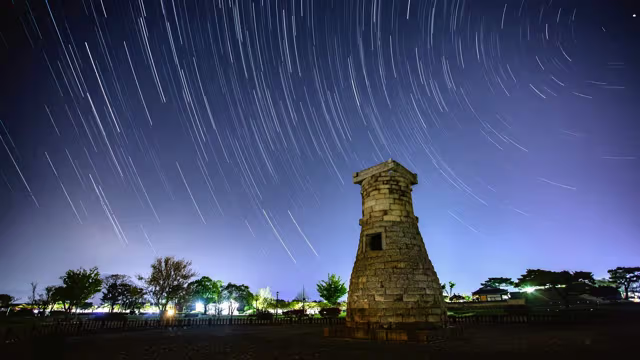
Most people first read Cheomseongdae as a symbol. It is small, old, photogenic, and instantly recognizable. In spring it sits behind flowers. At night it glows softly in the middle of Gyeongju. Which is exactly why many visitors stop at: “That is Korea’s old observatory,” and move on.
But Cheomseongdae becomes much more interesting once you ask a harder question: why would a 7th-century Korean kingdom spend labor, stone, and prime capital-city space on a sky-watching tower in the first place?
The short answer is that Silla did not treat astronomy as a hobby. It treated astronomy as state work.
That meant two things at once. Watching the sky helped a kingdom make and correct calendars, which mattered in an agricultural society. It also helped the court interpret unusual celestial events as signs tied to political order and royal fortune. In other words, old Korean astronomy sat between practical science and state cosmology. Cheomseongdae makes sense only when you keep both in view.
What Cheomseongdae actually is
Cheomseongdae in Gyeongju is widely treated as the oldest surviving astronomical observatory in Asia. The official heritage explanation dates it to the reign of Queen Seondeok of Silla, who ruled from 632 to 647. Its name literally means something close to “platform for gazing at the stars.”
It is a little over 9 meters tall, built from dressed stone on a square base, with a curved cylindrical body and a square top frame. Halfway up, there is a south-facing opening. Heritage records and later historical texts describe people moving through the middle and climbing to observe the sky from above.
That does not mean every scholar reduces it to a single-purpose instrument. The Korean heritage explanation itself notes that some people also read the structure as a ritual symbol or a commemorative monument. That is a useful reminder. In early states, science, state ritual, and symbolic architecture were not cleanly separated the way modern people expect them to be.
Still, the official reading remains clear: this was built as a place for astronomical observation. The scientific part of the story is real. It just belongs to an older world where observation, calendar-making, and state meaning were tightly connected.
Why Silla cared about astronomy so much
If you read old Korean sources on observatories, one point comes up again and again: watching the sky had two main purposes.
One was practical. A state needed to understand seasonal change, keep track of time, and maintain a workable calendar. That mattered for farming, taxation rhythms, rituals, and court administration. In a premodern agrarian kingdom, getting the calendar wrong was not a small inconvenience. It meant the state’s timing was out of sync with the world it was trying to govern.
The other purpose was political and cosmological. Celestial events were read as signs of the country’s condition. Eclipses, comets, strange stars, and unusual sky phenomena were not just “interesting.” They could be interpreted as warnings, confirmations, or disruptions tied to rule itself.
This is the part foreigners sometimes misunderstand. They assume that if astronomy was linked to omens, it was not serious knowledge. In Silla, the opposite was true. Because the stakes were high, the state had to watch carefully.
The Korean encyclopedia entry on observatories makes this especially clear in the case of Silla. It notes that after Cheomseongdae was built, Silla left more astronomical observation records in the following 288 years than it had in the previous 704 years. That does not prove every single record was made by standing on this exact tower. What it does show is stronger and more useful: astronomy had become more systematic, more institutional, and more deeply tied to the state.
That is the real scientific intelligence behind Cheomseongdae. Not a fantasy about “ancient secret technology,” but a kingdom deciding that the sky was important enough to observe in a disciplined way.
Why the structure is built like this
Cheomseongdae looks simple because its logic is simple.
It had to do three things at the same time:
- stand securely for a long time,
- let a person access the upper part of the structure,
- provide a raised place for observation.
Once you look at it that way, the form stops feeling mysterious.
The lower part is heavy and stabilizing. Official heritage guidance says the interior is filled with gravel and soil up to the 12th stone tier. That means the tower is not hollow all the way down like an empty chimney. The lower body acts more like a solid anchor, which makes sense for a tall stone structure built without modern reinforcement.
Above that filled lower section, the interior becomes hollow. The opening on the south side sits between the 13th and 15th tiers, which suggests a practical access point rather than a decorative hole. Heritage explanations presume that a ladder was used to enter there and another ladder was used inside to reach the top.
The shape of the outer wall matters too. The body swells lower down and becomes more vertical toward the top. Official descriptions note that profile directly. A reasonable structural reading is that this gives the tower a steadier lower mass while keeping the upper section narrower and easier to manage. In plain language: it is less like balancing a straight stone tube and more like building a stable body that rises into an observation point.
Then there is the top. Eight long stones are arranged in two layers to make a square frame that resembles the top of a well. That upper frame matters because the top is where the observational logic culminates. The tower does not end in a pointed cap or decorative crown. It ends in a flat, usable upper structure.
No telescope was involved. This was 7th-century astronomy. What mattered was clear sight, repeated observation, orientation, height above the surrounding ground, and stable access to the top.
So if you want the scientific explanation of the design, it is this: Cheomseongdae is a stone observatory shaped by access, stability, and line of sight.
Why the numbers matter, but not in the way internet trivia says
Cheomseongdae is famous for number symbolism. Official tourism explanations commonly read the tower’s stone count as the days of the year, the 27 tiers as a reference to Queen Seondeok as Silla’s 27th ruler, and the 12 tiers below plus 12 above the window as a calendar pattern tied to the months or the 24 solar terms.
That symbolic reading is not random. Ancient states did not divide practical astronomy from calendrical symbolism as neatly as modern people do. Embedding number logic in architecture would have made perfect sense in that world.
At the same time, this is where people sometimes oversimplify Cheomseongdae. They turn it into a giant stone code, as if the whole point were just a puzzle of hidden numbers. That misses the more important fact that the building had to work as a durable structure first.
It is better to think of Cheomseongdae as a building where symbolism and function meet. The numbers matter because the sky mattered. But the tower also had to hold its weight, preserve access, and survive.
What Cheomseongdae says about old Korean science
The most impressive thing about Cheomseongdae is not that it looks advanced in a modern engineering sense. It is that Silla recognized astronomy as infrastructure.
That matters because people outside Korea often meet premodern Korean science only as a footnote to somewhere else, or jump straight to later Joseon achievements. Cheomseongdae pushes back against that shallow picture. It shows a Korean kingdom building a durable observation structure, maintaining interest in celestial records, and folding that knowledge into governance.
It also shows something else that is very Korean in a long historical sense: knowledge was rarely kept in a purely abstract box. It was tied to seasonality, agriculture, ritual order, political legitimacy, and practical administration all at once.
That is why Cheomseongdae does not look like a modern observatory. It belongs to a different definition of science. But different does not mean vague or unscientific. It means the scientific work was embedded in the state’s larger understanding of how heaven, land, time, and rule were connected.
If you stand in front of Cheomseongdae with that in mind, the tower stops looking cute and starts looking disciplined. Compact. Intentional. Calmly intelligent.
How to look at Cheomseongdae when you visit
If you go in person, do not just photograph the silhouette and leave.
Start with the lower body. Notice how grounded it feels compared with the slimmer upper portion. Then find the opening halfway up and imagine what kind of ladder access that implies. After that, look at the square top instead of the curved middle. The whole building begins to read less like a monument and more like a platform system.
That is the shift most visitors miss. The tower is beautiful, but its beauty comes from functional clarity. Even now, the shape tells you what the builders cared about: stability below, access through the middle, observation above.
Frequently Asked Questions
Is Cheomseongdae really an observatory?
Yes, that is still the main official interpretation. Korean heritage authorities describe it as an astronomical observation structure built in the reign of Queen Seondeok. At the same time, some scholars also think it may have carried ritual or commemorative meaning, so it is best understood as a scientific structure in a world where science and symbolism overlapped.
Why did Silla care so much about astronomy?
Because astronomy was tied to both farming and rule. The court needed calendars and seasonal timing, but it also treated unusual celestial events as signs connected to the state’s fortune and political order.
Why is there a hole in the middle of Cheomseongdae?
The opening on the south side sits between the 13th and 15th stone tiers. The official heritage explanation reads it as an access point. A ladder likely reached that opening from outside, and another ladder may have been used inside to climb to the top for observation.
What is inside Cheomseongdae?
The lower interior is filled with gravel and soil up to the 12th tier. Above that, the upper part is hollow. That combination makes structural sense because it stabilizes the lower half while leaving usable space higher up.
What do the 27 tiers and other numbers mean?
Official tourism guidance connects the 27 tiers to Queen Seondeok as Silla’s 27th ruler, the 12 layers above and below the opening to the calendar, and the total stone count to the days of the year. These readings are part of how Cheomseongdae has long been interpreted, even though modern discussions sometimes debate the exact counting method.
Is Cheomseongdae the oldest observatory in Asia?
It is widely acknowledged as the oldest surviving astronomical observatory in Asia. That is the wording used in Korean heritage explanations and one reason the structure is so important in the history of Korean science.
When can you visit Cheomseongdae?
According to VisitKorea, Cheomseongdae is open year-round, free to enter, and generally operates from 09:00 to 22:00 in summer and 09:00 to 21:00 in winter.
Reporting note
Construction period, official interpretation, structural details, and the debate over observational versus symbolic function were checked against the Korea Heritage Service and the Encyclopedia of Korean Culture. Visitor hours, address, and admission were checked against VisitKorea on April 12, 2026.
Location Guide: Cheomseongdae Observatory
Loading map
Free. Summer 09:00-22:00, winter 09:00-21:00. Open year-round.