
Why Cheongdam Bridge Works So Well in KPop Demon Hunters
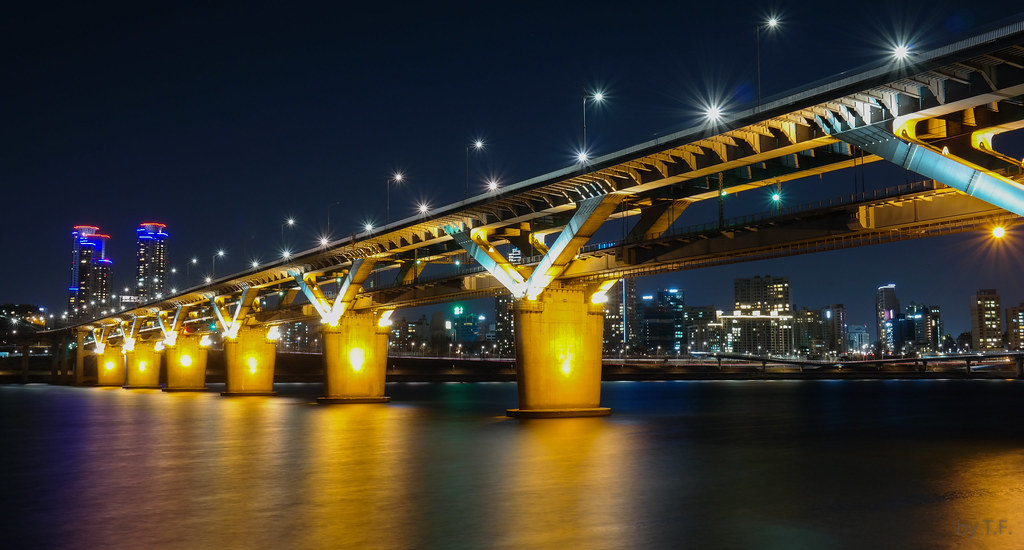
When KPop Demon Hunters throws HUNTR/X onto a speeding train crossing the Han River, the scene does not feel random. It feels specific. That is because the movie is not using just any Seoul bridge. It is using Cheongdam Bridge, one of the city’s clearest symbols of movement, scale, and modern infrastructure.
Netflix’s own location guide identifies Cheongdam Bridge as the bridge in that sequence, where Rumi, Mira, and Zoey fight demons on top of a train and launch into “Takedown.” The more useful question, though, is not just whether the bridge is real. It is why this bridge fits the movie so well.
The answer is that Cheongdam Bridge already looks like an action storyboard for modern Seoul. It carries the subway under a road deck, slices across the Han between Gwangjin and Gangnam, and reads less like a scenic promenade than a machine for keeping the city in motion.
What Cheongdam Bridge actually is
Cheongdam Bridge is a real bridge over the Han River linking Jayang-dong in Gwangjin-gu with Cheongdam-dong in Gangnam-gu. Seoul’s official travel guidance describes it as Korea’s first double-deck bridge. The lower deck carries Subway Line 7, while the upper deck carries motor traffic.
That detail matters more than the bridge’s name recognition. Cheongdam Bridge is not famous in the same way Banpo Bridge is famous for fountains or Olympic Bridge is famous for its pylons. Its identity is more functional than symbolic. It is a transport structure first.
Which is exactly why it works in KPop Demon Hunters.
Why the bridge feels right for that train battle
Most bridges in movies are used for height, suspense, or skyline drama. Cheongdam Bridge gives you those things, but it also gives you something more specifically Seoul: layered transit.
The bridge puts a subway train inside the river crossing itself. That means the action does not happen beside Seoul’s infrastructure. It happens on it.
This is what makes the scene feel so local even inside a stylized animated city. The movie is not borrowing a generic bridge silhouette. It is borrowing a very Seoul kind of movement: train below, road above, river underneath, towers at the edges, and the whole city still pushing forward at speed.
That is also why the sequence feels more convincing than if the film had used a prettier but simpler bridge. HUNTR/X are idols, but they are also workers moving through a giant city under pressure. Cheongdam Bridge fits that rhythm. It is glamorous from a distance, but its real character is throughput.
Why the double-deck design matters
If you are not used to Seoul, the bridge can seem like a technical oddity. For locals, it reads as a very practical kind of urban decision.
Seoul is a city that has to stack functions. Roads, rail lines, riverbanks, parks, apartment districts, and business zones keep colliding with one another. Cheongdam Bridge solves that problem in a way that is visually memorable because it layers movement instead of spreading it out.
That is the part the movie understands.
KPop Demon Hunters is full of old Seoul and symbolic Seoul, but it also needs fast Seoul. It needs concrete, rail, night light, and the feeling that crossing the river is not a pause in the city but one of the places where the city feels most intense. Cheongdam Bridge does that naturally.
The bridge is also useful as a visual shorthand for a particular part of Seoul’s geography. Cheongdam on one side immediately suggests Gangnam’s polished image and entertainment-world associations. The Han River underneath gives the frame scale. And the train gives the scene a built-in line of motion before the fight even starts.
So the bridge is doing narrative work before anyone throws a punch.
What foreigners often miss about this part of Seoul
Visitors often divide Seoul too neatly into old and new.
Old Seoul becomes palaces, hanok, fortress walls, and traditional markets. New Seoul becomes Gangnam towers, LED screens, and the Han River at night. The city itself is not organized that cleanly. It moves by layering systems on top of one another.
Cheongdam Bridge is a good example of that logic. It is not a heritage landmark, but it is still very Korean in how it solves urban density. It is compact in concept even if it is large in scale. One bridge, two transit levels, river crossing, district connection, and an instantly recognizable night profile.
That is why the bridge feels so believable in KPop Demon Hunters. The movie is not inventing a futuristic Seoul out of thin air. It is exaggerating a city that already likes stacked functions, compressed movement, and visually legible infrastructure.
Can you actually walk on Cheongdam Bridge?
Not in the way many movie fans imagine.
This is not a strolling bridge with a pedestrian deck built for sightseeing. Seoul’s official bridge guidance describes the upper deck as motor traffic and the lower deck as Subway Line 7. So if you want the movie feeling, the right move is not to treat Cheongdam Bridge like a place to wander across on foot.
The better approach is to see it from the edges.
Seoul Metropolitan Government specifically recommends viewing Cheongdam Bridge from Ttukseom Hangang Park. From the Gangnam side, Cheongdam Reservoir Park also gives you a clear view of Line 7 passing under the bridge and a strong evening perspective over the river.
That difference matters. In real life, Cheongdam Bridge is something you watch, ride through, or pass under. That matches the film more than a slow tourist walk would.
How to see the bridge in real life
If you want the cleanest public-facing view, start on the north side at Ttukseom Hangang Park. Seoul city guidance points visitors there for Cheongdam Bridge, with easy access from Line 7 on the riverside park side.
If you want a more compressed Gangnam-side view, Cheongdam Reservoir Park is useful. Seoul city guidance describes it as a place where you can watch Line 7 passing under the bridge during the day and catch the bridge reflecting over the river at night.
The key thing to notice is not just the outline. Watch for the train. Once a Line 7 train slides through the lower deck, the logic of the bridge becomes obvious, and the KPop Demon Hunters scene suddenly makes much more sense.
Frequently Asked Questions
Is Cheongdam Bridge in KPop Demon Hunters real?
Yes. Netflix Tudum’s official location guide identifies Cheongdam Bridge as the real Seoul bridge reimagined in the movie’s train battle sequence.
What happens at Cheongdam Bridge in KPop Demon Hunters?
It is the bridge where Rumi, Mira, and Zoey fight demons on top of a speeding train crossing the Han River and begin singing “Takedown.”
Why is Cheongdam Bridge so distinctive?
Because it is Korea’s first double-deck bridge. The lower level carries Subway Line 7 and the upper level carries motor traffic, which gives it a layered, high-speed feel that is visually perfect for modern Seoul action scenes.
Can you walk across Cheongdam Bridge?
It is better to think of it as a transport bridge, not a pedestrian sightseeing bridge. The upper deck is for vehicles and the lower deck is for the subway, so most visitors experience it from nearby riverfront areas rather than by walking across it.
Which subway line uses Cheongdam Bridge?
Subway Line 7 runs on the lower deck of the bridge.
Where is the best place to view Cheongdam Bridge?
Seoul Metropolitan Government recommends Ttukseom Hangang Park for bridge views. Cheongdam Reservoir Park on the Gangnam side is also useful if you want to watch Line 7 pass under the bridge and catch the night reflection.
Is Cheongdam Bridge only interesting because of KPop Demon Hunters?
No. The movie gives it a new pop-culture reference point, but the bridge was already a recognizable piece of Seoul infrastructure because of its double-deck design and Han River setting.
Reporting note
The KPop Demon Hunters bridge reference and scene description were checked against Netflix Tudum. The bridge’s double-deck structure, district connection, and Jayang Station access were checked against Visit Seoul. Public viewing guidance for Ttukseom Hangang Park and Cheongdam Reservoir Park was checked against Seoul Metropolitan Government pages on April 12, 2026.
Location Guide: Ttukseom Hangang Park viewpoint for Cheongdam Bridge
Loading map
A good public viewpoint for Cheongdam Bridge is Ttukseom Hangang Park. Seoul city guidance recommends this side for bridge views.